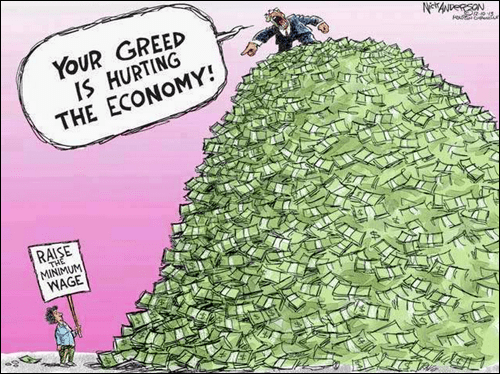
Contrary to popular belief, the rich people today are not the ones with the most talent; they’re the ones with the most luck.
In Tiffany Ferguson’s podcast, Wealth Inequality! Student Debt! Universal Basic Income!, she discusses income inequality and the serendipitous ways our economy works. She states how this inequality has gotten so bad to the point of where, “8 men have the same amount of wealth as 3.8 billion people”. The mere fact that this statistic could be true illustrates the need for our system to be revolutionized. So few people shouldn’t own so much wealth. Ferguson also mentions that instead of what’s generally thought, “the harder you work, the more successful you’ll be and the more money you’ll have”, what typically occurs in our system is luck determining the extent of your success. One has just as much chance of getting extremely wealthy as a character they play in the board game “life”.
Further, going off of Ferguson’s insightful recognition of this role ‘luck’ plays in our economy, I think it’s noteworthy to also point out that those with wealth will always attempt to convince others that they worked hard for their money and that their success is an indicator of their hard work and intelligence. Case in point, when Hillary Clinton pointed out that trump paid 0 dollars in taxes, he responded with, “That makes me smart.” In other words, Trump believes that hoarding wealth suggests someone is intelligent. Though, I don’t believe the mindset of “I must be so smart and so talented to have accumulated so much wealth and be so successful” is necessarily sound.
I can respect the fact that some rich people are smart (Bill Gates, Steve Jobs, etc) but if you were to examine their life before they were successful, you could most likely find significant lucky events that led to their success. And to an extent, their intelligence is what allowed them to manipulate those lucky events into a way to produce success and wealth. However, that doesn’t dismiss those events and the fact that without them, they’d just be another undiscovered genius. In fact, there are probably so many of these undiscovered geniuses that don’t get to share their knowledge because of the inequalities that are systematically implemented in our economy and that automatically put communities at disadvantages because of characteristics like race, class, and gender.
Another interesting skewed statistic to examine when investigating unprecedented inequality is the fact that the average white family makes about 13 times as much annual income than the average black family. This further elucidates the assertion that success is based on the ‘luck’ of being born into a privileged situation, in this case a white family.
Often, however, this inequality is debated. A good amount of people in the lower class will argue and defend the upper class with statements about how they earned their money. The main reason for this is the hope that they will one day be in the same situation and have the same struggle of trying to hoard as much money as they can. Clearly and obviously an unrealistic, impractical hope based on an immense amount of research and statistics on the probability of ‘escaping your class’. This hoarding of cash they wish to accomplish is also another major issue of our system that I discussed in my previous blog, The Fault in Our Capitalism.
When seeing articles about how Jeff Bezos has more money than anyone can mathematically spend in a lifetime and that he could solve world hunger and climate change and still have billions of dollars, it makes me infuriated. The essential workers that our society depends on continue to suffer and struggle under the hands of capitalists, and those who own capital are too selfish to do anything about it. It’s ridiculously immoral and discredits those at the bottom of the class system who most often do the most crucial work. Without those amazon workers who weren’t as lucky, Jeff Bezos wouldn’t have been able to be so successful. The immensely rich may have an abundance of cash, but they’re morally bankrupt.
 caro's blogs