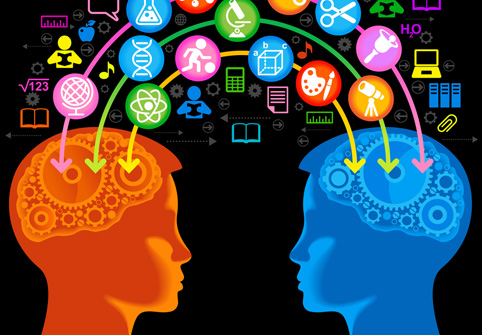
The learning process is about opening your mind to ideas and building on what you know to have a deeper understanding of diverse topics. In order for this to take place, it’s important for learners to collaborate with others in discussions about the topics they’re learning about as well as make connections with those you’re learning from.
One of the best ways, in my opinion, to show that someone is learning, is to see if they’re capable of having a conversation with others about the topic at hand. Being able to have a multi-sided discussion illustrates the understanding of a subject because without proper knowledge, it would be difficult to have a meaningful conversation. Therefore, one way to facilitate learning is to spark discussions and encourage working together with others.
Though the ideal for this might look different for different individuals. For example, I tend to be more on the quiet, introverted side and typically smaller groups and settings allow me to feel more comfortable in conversations. Although, others may enjoy larger audiences to share their thoughts with. In a standard classroom learning environment, both means of discussion would be important to incorporate the needs of both introverted and extroverted students.
Another important aspect of learning is the person you’re receiving the information from.
Going back to the classroom setting, a common person to receive information from is your teacher. As a student in high school myself, when I picture learning, most of the time the image that comes into my head is a teacher talking in front of a class full of students. From my own experience, the classes in which I not only did well in the course, but I also retained and utilized the instruction outside of the course were those where I had a relationship with the teacher.
Building relationships with the person you’re communicating with is one of the most vital parts of the learning process. Not only did it allow me to be more comfortable in participating in the exchange of information, but it also allowed me to see the perspective of that person and connect with them in order to have a more worthwhile discussion which encouraged use of the information outside of the classroom.
Apart from the learner’s responsibilities, I think another key aspect of learning is the method in which someone is teaching you.
Being a teacher with the job of helping students learn is one of the most difficult and intricate careers to be in because of how difficult and intricate it is to understand everyone’s learning process or learning philosophy.
Ergo, teaching must be approached as a performance that’s both entertaining to engage students but also malleable to accommodate changes in the direction of discussions. This, however, is a heavy burden for teachers to carry and therefore often isn’t how lesson plans occur. Though this is the ideal, it isn’t frequently taking place.
It feels necessary to acknowledge the fact that a classroom or school environment is far from the only place where learning occurs. However, it is one of the easiest examples to use in order to elucidate my learning philosophy because it is the only place in which learning is structural and planned. Therefore, my intention was to illustrate a loose idea or concept of what learning should look like that could be applied onto a range of other areas of learning.
 caro's blogs
Great thinking here, Caro. Great writing, too! (I’m glad you got an “ergo” in there). I really appreciate the focus on relationship in this response–it’s how I learn best, too. This is a sort of dialogic philosophy which has a lot in common with what Plato may have envisioned, but is also quite forward-thinking. One of the leading thinkers in justice-oriented educational thought was a dude named Paolo Freire, who wrote in his Pedagogy of the Oppressed about how often educational settings are sites of oppression, where the teacher sees himself as the only expert in the room, and the kids are expected to cram stuff into their brains. This stands in opposition to what he sees as a just classroom, which is one where teacher and students become co-learners together, and students are offered the opportunity to question the WHAT and WHY of learning.
LikeLike